How scoring works
Risenoow gives every applicant the same reading: the AI reads what they wrote and said, scores it against the role, and shows you the candidate's own words under every score. Scores are a reading for your team to weigh, not a decision. This page explains, in plain English, where each number comes from and what is never judged.
Where: Every candidate record, and the Match score and CV fit columns on the Candidates list
Who it is for: Anyone who reads or acts on a Risenoow score
Time needed: Five minutes to read
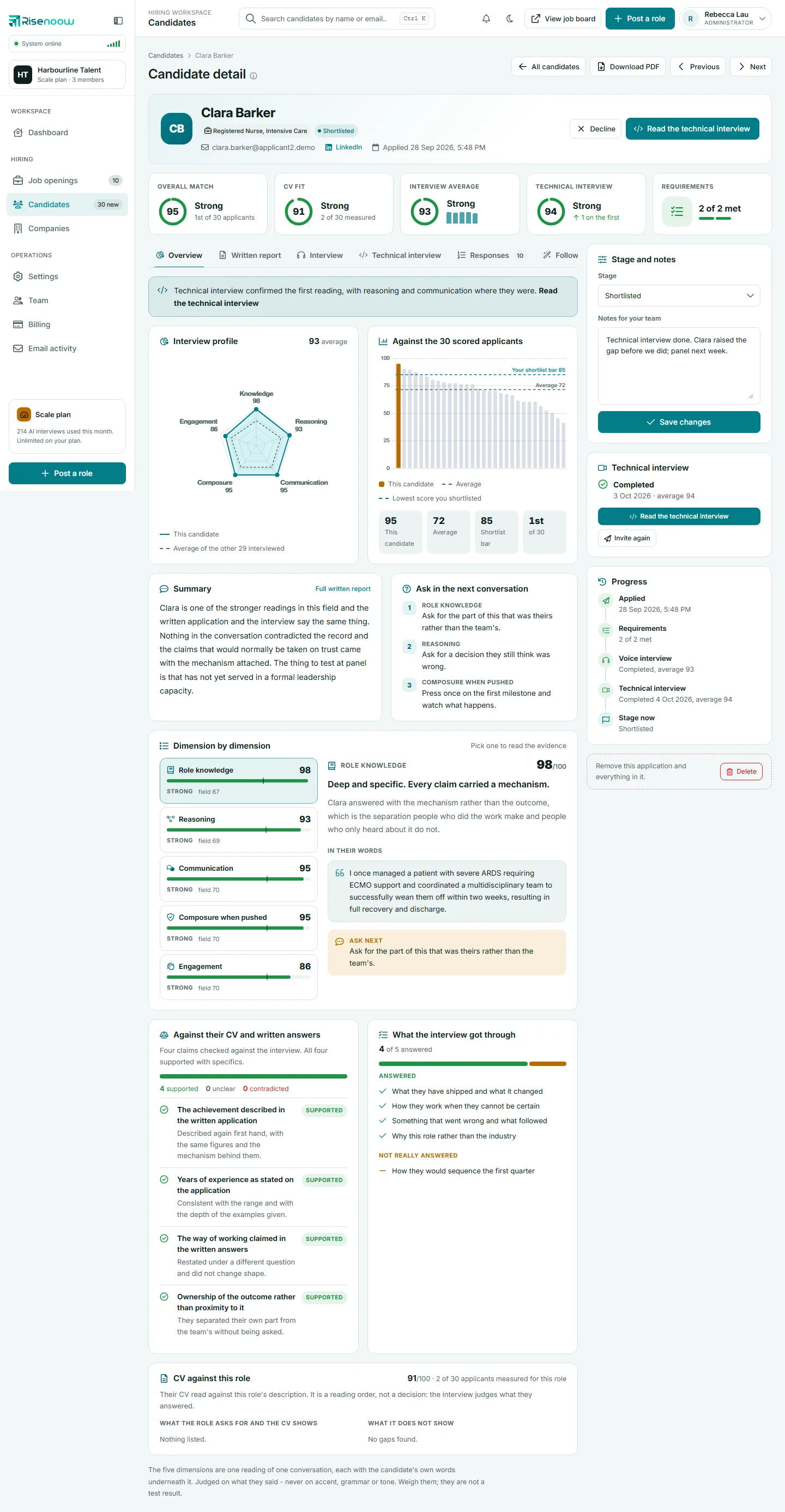
What feeds the overall match
The Overall match is the score the written report gives, out of 100. When a candidate finishes applying, the AI reads everything they supplied:
| Source | How it is treated |
|---|---|
| Written answers | Evidence, judged against this role |
| Voice interview | Only the candidate's own lines count. The AI interviewer's questions are never evidence about the candidate |
| The five dimension reading of the interview | A summary of the scores and any contradicted claims, given to the report as context |
| Follow up answers | Evidence, like the written answers |
| CV | Their own claim about themselves, not verified fact. What they could explain in their own words counts for more |
| Career profile and cover letter | Read when the candidate supplied them |
The AI judges against this role, not candidates in general, and prefers specifics: what they did, decided, shipped or measured. A confident claim with no detail behind it is treated as a gap, not a strength. Length is not rewarded, and an unanswered question is never counted in their favour.
The report is written in the language of the role, and ends with a recommendation. See Written report tab.
Every score carries the candidate's words
Each of the five interview dimensions comes with one to three passages the candidate actually said, copied exactly from the transcript. Select one on the record and the transcript opens at that line. If the AI cannot find a quote for a dimension, it must say so and mark the score low confidence; it is not allowed to guess. See Dimension by dimension.
The written report follows the same rule: every strength, gap and score must trace back to something the candidate supplied.
When there is too little to score
Risenoow would rather show no number than a number resting on nothing.
- Nothing supplied. No written answers, no follow up answers and no words spoken: the report is labelled as insufficient evidence and no score is given.
- Very little supplied. Two or fewer written or follow up answers and under 40 spoken words: the report is labelled as too little to score, says what was supplied, and no score is given.
- A short interview. The five dimensions are only read when the candidate spoke at least twice and said at least 60 words. Otherwise the record says the interview was too short to score.
In the first two cases the Overall match tile reads Not scored, with "Too little to judge, see the report" under it, and the list shows Not scored. Ask the candidate for more before deciding anything.
What is never judged
The interview reading works from the transcript only. It never judges, mentions or is influenced by:
- accent, grammar or vocabulary range,
- filler words, hesitation, repetition or correcting themselves,
- anything that looks like a transcription error,
- emotion, personality, confidence or state of mind,
- age, race, nationality, gender, religion, disability, health, pregnancy, family, or anything that stands in for them.
Two things are deliberately not measured at all. Intelligence is not scored; Reasoning is, meaning how somebody worked through a problem in what they said. Sentiment or tone is not scored, because tone is often nerves, first language or culture; Engagement is, meaning interest in this role shown by what they asked and knew.
Communication is judged on substance only: was the answer clear, organised and specific. Speech to text tools are less accurate with some accents, so judging tidy sentences would penalise people for how they speak.
CV fit is a separate reading
The CV fit score reads the CV alone against the job description. It has not seen the interview or any answers. It exists to help you decide who to read first. Someone can score 50 on CV fit and 78 on the overall match because they interviewed well, and that is correct. See Claims and CV checks.
The technical interview stands beside the first
A technical interview is read with the same five dimensions and compared with the first. It does not replace the first score. The one line summary of what changed, such as "Technical interview confirmed the first reading", is worked out from the two sets of scores, not written by the AI, so it cannot flatter. A fall of 12 points or more on any dimension leads that line, and moves of 8 points or more are named.
Readings do not change behind your back
Every reading is stored once, at the time it was made, and is never run again when you open the record. A requirement you change on the role tomorrow does not rewrite what was recorded about someone yesterday. The only exception is Run the analysis again, offered when a written report is missing. It follows the same evidence rules as the first run, and the candidate keeps their current stage: only a candidate still at New moves to AI reviewed.
Scores are a reading, not a decision
No score moves a candidate forward or turns them down. Stages change only when someone on your team changes them, and both Shortlist and Decline ask you to confirm because the candidate is emailed. The one automatic step is a requirement question you set to decline when it is not met: an application that fails it is declined automatically, and the record says so. See Requirements tab.
Good to know
Read a score the way you would read a colleague's notes: useful, specific, sometimes wrong. The quotes are there so you can disagree in seconds.
Frequently asked questions
Why does the overall match differ from CV fit?
They read different things. CV fit reads the CV alone. The overall match reads the written answers, the interview, the follow ups and the CV together.
Could a candidate game the score by writing instructions in an answer?
Everything the candidate writes is treated as evidence, never as instructions. If an answer addresses the AI or states its own score, the report flags it under gaps and concerns, and only the score the report gives in its own words is used.
Is a score of 50 a fail?
No. 50 means an ordinary answer for the role. The words help: 80 and up is Strong, 65 Solid, 50 Mixed, 30 Limited, below that Little evidence.
Does the AI hear the candidate's voice?
The scoring works from the written transcript of the interview. Tone, pace and sound are not part of the reading.